
The Centre has allocated Rs 73,000 crore to the rural employment guarantee programme Mahatma Gandhi National Rural Employment Guarantee Act for the next fiscal 2021-22, substantially lower than the actual expenditure of Rs 1.11 lakh crore in the current fiscal which included an additional Rs 40,000 crore for the scheme given by the government in the wake of the pandemic's impact on the economy.

Nirmala Sitharaman on Wednesday assumed charge as the Finance and Corporate Affairs Minister for the second consecutive term and is slated to soon present the final Budget for FY '25 that is going to set the tone for the Modi 3.0 government's priorities and direction for Viksit Bharat. Upon her reaching the North Block office, Sitharaman was greeted by Finance Secretary T V Somanathan and other top officials. Minister of State for Finance Pankaj Chaudhary was also present. Chaudhary assumed charge on Tuesday evening.

While presenting her 2021-22 Union Budget, Finance Minister Nirmala Sitharaman had set a fiscal deficit target of 6.8 per cent of nominal gross domestic product (GDP) against the 2020-21 Revised Estimate of 9.5 per cent. The fiscal correction in the upcoming 2022-23 Union Budget is unlikely to be that steep. Even as discussions among top Budget-makers are ongoing, the fiscal deficit target for 2022-23 may likely be in the range of 6.5-6.8 per cent.

The company has the largest car park in EVs in India, estimated to be around 170,000 units. As a pilot, it has already started work with used online car marketplace Spinny.

Women and children have been given short shrift with these crucial sectors facing substantive budgetary cuts, discovers Rashme Sehgal.

If there is no third wave of the pandemic, the fiscal position of the Centre and the states will be much better than budgeted for FY22 and the states may garner Rs 60,000 crore more in tax collections at Rs 8.27 lakh crore this fiscal year than they have budgeted, a report said. The report by SBI Research on Monday bases its optimism on GST collection so far this fiscal, which has been the best ever in spite of the fact that the two months bore the maximum brunt of the second wave -- with April setting a record Rs 1.41 lakh crore and May collection a tad low at Rs 1.03 lakh crore. The report also said overall government finances do not look overstretched as GST collections have continued to maintain pace so far and the additional fiscal impact arising from free vaccination and more food supplies will only be around Rs 28,512 crore.

State-owned oil firms such as ONGC and IOC will invest over Rs 1.11 lakh crore in the next fiscal year starting April as they supplement the government's massive spending programme to spur economic growth. Oil and Natural Gas Corporation (ONGC), Indian Oil Corporation (IOC), GAIL (India) Ltd, Bharat Petroleum Corporation Ltd (BPCL), Hindustan Petroleum Corporation Ltd (HPCL) and Oil India Ltd (OIL) will together make a 7.4 per cent higher capital expenditure in the 2022-23 fiscal (FY23). The capex spending of Rs 1.11 lakh crore in 2022-23 compares with a revised estimate of Rs 1.04 lakh crore for the current fiscal year that ends in March, according to Union budget documents.

The central government's net borrowings till July 25 stood at Rs 52,715 crore (Rs 527.15 billion), nearly 50 per cent of the budget estimate of Rs 1,07,194 crore (Rs 1071.94 billion) for 2003-04, according to PNB Gilts.

The Child Protection Services programme under the Integrated Child Development Services was increased to Rs 1,500 crore from Rs 925 crore.

Terming infrastructure as the "backbone" of any nation's development, Goyal while presenting the interim Budget for 2019-20 in the Lok Sabha said India aspires to be a USD 10 trillion economy in the next eight years, and on the anvil is next generation infrastructure of roads, railways, seaports, airports, urban transport, gas and electric transmission and inland waterways.

GST collections touched a record of Rs 1.40 lakh crore in January on rapid economic recovery, Finance Minister Nirmala Sitharaman said on Tuesday. In her 2022-23 Budget speech, the minister said there has been a remarkable progress made in the Goods and Services Tax (GST) regime, but still a few challenges remain. "Gross GST collection in January at record Rs 1,40,986 crores; this has been possible due to rapid economic recovery," she said while presenting the Budget in the Lok Sabha. January is the seventh straight month when the GST collection has crossed the Rs 1 lakh crore mark.

The scarcity of resources is particularly evident in the case of Rajasthan compared to many other states.

The rise in the fiscal deficit, which is a reflection of the government's borrowing, was mainly on account of subdued tax collection. The revenue deficit also rose to 3.27 per cent, up from the revised estimate of 2.4 per cent of the GDP.

CII has also called for tax incentives for new health care projects and import duty relief for lifesaving equipment.

At present, workers whose basic wage at the time of joining is up to Rs 6,500 per month.

A combination of factors, including heavy investments in US Treasury bonds and dollar sales at a healthy profit, facilitated the Indian central bank in transferring a record surplus of Rs 2.11 trillion to the government for 2023-24 (FY24). The RBI's dollar purchases increased in FY24, supported by robust capital inflows endorsing the economy's health.

But it is disappointing to note that Sitharaman's third Union Budget continues to promote a few problematic ideas, observes A K Bhattacharya.

Flipkart's hyper-value e-commerce platform Shopsy is intensifying efforts to tap over half of the 821 million internet users (about 442 million) in rural India. These efforts are being led by Prathyusha Agarwal, who recently joined as business head at Shopsy. The aim is to become the go-to destination for consumers seeking entry-level products across various categories.
Indian Airlines has reported a loss of Rs 246.75 crore and approved the dry-lease of five additional Airbus A-320 aircraft for 3 years.

The Reserve Bank on Friday approved the transfer of Rs 99,122 crore as surplus to the central government for the accounting period of nine months ended March 31.

In 2009, FinMin proposed to move regulators' reserves into public account. These accounts were finally opened in 2013-14. However, no funds have been deposited in it so far.

While the fiscal year has just begun, any windfall surplus will be welcomed by the government as it bids to meet the fiscal deficit target of 5.9 per cent of GDP, amidst lack of clarity on exactly to what extent will recession in the West impact India's trade and tax collections.
The challenges before the coming Budget are more daunting than those in 2021, reveals A K Bhattacharya.

'Like every Budget, this time, too, there is chatter around tinkering with the long-term capital gains tax.' 'Investors may not want to jump into the markets until there is clarity on this front.'

Ahead of Union Budget, the government on Thursday said it hopes to exceed the indirect tax collection estimate of Rs 3.36 lakh crore for this fiscal in view of the buoyancy in the economy.

The Union Budget on Wednesday outlined several initiatives to drive India's technology agenda and boost digital infrastructure, including new centres of excellence for artificial intelligence, National Data Governance Policy, and Entity DigiLocker.

For the cooperation ministry, the government made a total budget outlay of Rs 1,150.38 crore for 2023-24, lower than the revised estimate of Rs 1,624.74 crore for 2022-23.

Singh also said a final decision on the launch of India's sun mission 'Aditya-L1', scheduled for September 2 at present, will rest on the prevailing cosmic aspects.

While most experts suggest the government loosen its purse strings and not worry about the fiscal deficit in a pandemic impacted year, it will be a tightrope walk for the government to increase spending without going overboard.

Sitharaman also said that the government's capital expenditure was on track and Budget estimates would be met.
Chief executive officers (CEOs) across sectors have expressed intentions to expand capacities, expecting the government's target to invest a record Rs 11.11 trillion on infrastructure development will act as a catalyst for a jump in consumer demand. "With the government planning a capex of Rs 11.11 trillion, private sector investment will come in a big way. Companies will be preparing for it right from today," H M Bangur, chairman of Shree Cement, told Business Standard. For the past few years, the investment scene in India has been dominated by government capital expenditures; private investments in the manufacturing sector have remained muted.
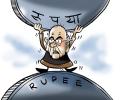
Fiscal deficit in first half of FY19 has already reached 95.3 per cent of full-year budget estimates.

Budget announcements will come right before five states, with population of around 250 million, go to polls.

Global rating agency Moody's on Monday raised India's growth forecast for 2024 calendar year to 6.8 per cent, from 6.1 per cent estimated earlier, on the back of 'stronger-than-expected' economic data of 2023 and fading global economic headwinds. India's real GDP expanded 8.4 per cent year-over-year in the fourth quarter of calendar year 2023, resulting in a 7.7 per cent growth for full-year 2023. Capital spending by the government and strong manufacturing activity have meaningfully contributed to the robust growth outcomes in 2023, Moody's Investors Service said.

The Union Government's fiscal deficit remained above the annual target for second month in row at the end of August, mainly on account of the impact of lockdown on revenue collections. According to the data released by the Controller General of Accounts (CGA), fiscal deficit during April-August was at 109.3 per cent of the annual target estimated in the Budget.

The fast interceptor craft delivered can patrol the coastline at a scorching speed of 45 knots.

In recent years, excise duty collections had always played truant to the expectations.

There are several welcome standalone reforms, but these do not add up to a coherent strategy to achieve a $5 trillion economy or secure Aatmanirbharta, observes Rathin Roy.

Expressing commitment to augment the country's infrastructure, Finance Minister Nirmala Sitharaman on Monday proposed to significantly enhance capital expenditure to Rs 5.54 lakh crore in the next fiscal, besides creating institutional structures and giving a big thrust to monetizing assets to achieve the goals of the National Infrastructure Pipeline (NIP). Sitharaman said NIP, that was launched in December 2019 with 6,835 projects, has now been expanded to 7,400 projects and around 217 projects worth Rs 1.10 lakh crore under some key infrastructure ministries have been completed. "For 2021-22, I propose a sharp increase in capital expenditure and thus have provided Rs 5.54 lakh crores which is 34.5% more than the BE of 2020-21," the finance minister said.
 © 2026 Rediff.com - Advertise with us - Disclaimer - Privacy Policy - Sitemap - Feedback - About us - Terms of use - Grievances